Zodiac sign · ♉ Taurus
Taurus in Tarot
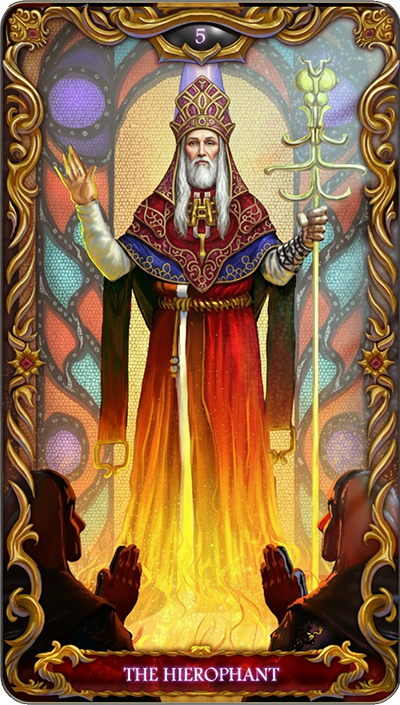
Taurus tarot correspondences explore The Hierophant's meaning, archetype, and spread uses. Discover intuitive clarity with psychoanalytic insight.

- Type
- Zodiac sign
- Element
- Earth
- Major Arcana
- The Hierophant
- Elemental suit
- Pentacles
- Source
- Golden Dawn / Book T

Major Arcana correspondence
In the Golden Dawn / Book T system, Taurus is attributed to The Hierophant. This correspondence places The Hierophant's themes of tradition, spiritual wisdom, institutions under the influence of the Taurus archetype. When The Hierophant appears in a spread emphasising astrological timing, the reader may consider the current Taurus season.
Pip card correspondences
In the Book T decanic system, the nine pip cards 2–10 of the Pentacles suit are distributed across the three zodiac signs sharing the Earth element. The cards below are the full set of Pentacles pips associated with this element grouping.
- Two Two of Pentacles balance, adaptation, juggling priorities
- Three Three of Pentacles collaboration, craftsmanship, mastery
- Four Four of Pentacles security, control, saving
- Five Five of Pentacles hardship, isolation, financial loss
- Six Six of Pentacles generosity, giving and receiving, charity
- Seven Seven of Pentacles patience, long-term view, investment
- Eight Eight of Pentacles mastery, apprenticeship, diligence
- Nine Nine of Pentacles independence, self-sufficiency, luxury
- Ten Ten of Pentacles legacy, family wealth, long-term success
Taurus in Tarot: Correspondence, Timing, and Reading Meaning
The Golden Dawn Attribution
Taurus corresponds with The Hierophant in the Golden Dawn-derived tarot attribution system. The important point is not to turn this into a rigid personality label. The correspondence is a symbolic bridge: it lets the reader connect the card’s imagery with astrological timing, elemental emphasis, and archetypal force.
This system became influential because Rider-Waite-Smith and Thoth-style interpretation inherited much of the Golden Dawn framework, even when the published decks do not explain every attribution on the card face. In a modern reading, Taurus is therefore best used as a second layer. Read the card first. Then ask what the Taurus correspondence adds: timing, temperament, pressure, or a mythic lens.
The Decanic Cards
Taurus’s decanic layer is more granular than the Major Arcana attribution. In practical reading, the three decan cards show how the sign behaves across smaller bands of experience rather than as one broad archetype.
- Five of Pentacles shows the first expression of Taurus: the raw premise, initial pressure, or first visible movement.
- Six of Pentacles shows the middle expression: development, complication, and the point where the sign must adapt.
- Seven of Pentacles shows the final expression: consolidation, consequence, or the completed lesson of the sign.
These cards are useful for timing, but they are not a substitute for the actual question. If one of them appears in a spread, read it first as a tarot card, then add the Taurus layer as a refinement.
Using the Taurus Correspondence in a Reading
Use Taurus in two main ways: timing and character archetype. For timing, the correspondence may point to a zodiac season, planetary emphasis, or a period when the question’s energy becomes more visible. For character work, it shows how the person or situation is behaving, not who someone permanently is.
A worked example: if The Hierophant appears in an advice position, the reading may ask the querent to work with Taurus’s function consciously. That can mean acting with more structure, listening to intuition, accepting a limit, or allowing renewal depending on the topic. If it appears in an obstacle position, the same correspondence may show the shadow: the archetype being overused, denied, or projected onto someone else.
Common Misreadings
The most common mistake is treating Taurus as a personality test. Tarot correspondence is not the same as a full natal chart, and one card cannot summarize a person. The second mistake is applying Golden Dawn attributions to every deck automatically. If the deck is Marseille-based, scenic and astrological correspondences may be less central than number, suit, and visual pattern.
A third mistake is using astrology to avoid the card’s direct meaning. If The Hierophant appears, the reader should still interpret the card’s image, position, and surrounding cards before adding the Taurus layer.
How Rider-Waite-Smith and Thoth Differ
Rider-Waite-Smith often embeds correspondences quietly through image, posture, color, and narrative. Thoth tends to make the esoteric layer more explicit through titles, planetary glyphs, and denser symbolic design. For Taurus, both traditions can support the same broad attribution while emphasizing different reading habits. RWS leans toward story and recognizable scene; Thoth leans toward system, force, and occult architecture.
Frequently Asked Questions
Which tarot card represents Taurus?
The Hierophant is the primary tarot correspondence for Taurus in the Golden Dawn-derived system used by many modern decks. Treat the attribution as an esoteric reading layer, not as the only way to read the card.
How is Taurus used in a tarot reading?
Taurus is used for timing, archetypal emphasis, and symbolic emphasis. A reader may treat it as a season, a planetary function, or a character tone depending on the question and the spread position.
Does every tarot deck use the Taurus correspondence?
No. Golden Dawn, Rider-Waite-Smith-influenced, and Thoth-influenced decks often preserve these correspondences, but Marseille-style reading does not require them. Use the system that matches the deck and reading method.