Major Arcana · 17
The Star
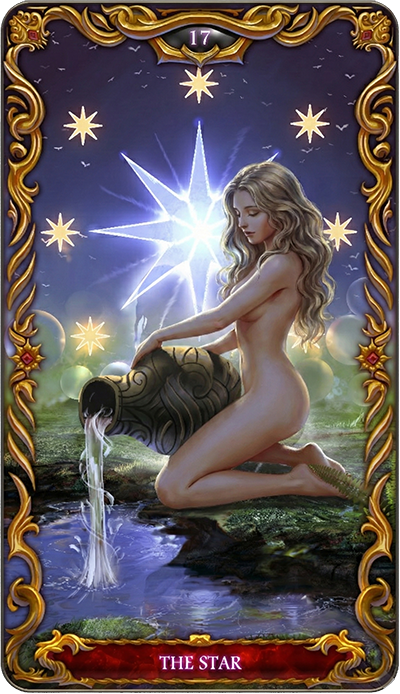
The Star tarot card means hope and renewal after hardship. Compare upright and reversed meanings, then apply its message in love, career, and reflection.

- Number
- Eight
- Element
- Air
- Zodiac
- Aquarius
- Hebrew letter
- Tzaddi

The Star Tarot Card: Meaning, Reversed, Love & Career
What does The Star mean?
The Star reflects hope and renewal after disruption, not a promise that events will turn out a certain way. Within the Major Arcana sequence, it follows The Tower and asks how trust might return without denying what has been lost.
Use three questions to make that theme practical: What has actually been depleted? What evidence of support or possibility remains? What small act would reopen flow without demanding certainty? Upright, the card emphasizes openness to that process. Reversed, it asks what makes hope or care difficult to notice, trust, or receive.
The Star upright meaning
Upright keywords: hope, inspiration, serenity, renewal
Upright, The Star can mark a gradual replenishment of attention, trust, or creative energy after a difficult period. Its hope is modest but usable: the future does not need to be guaranteed before you acknowledge what is still alive, supportive, or worth trying.
Hypothetical example: After a creative proposal is rejected, a person notices one piece of usable feedback and designs one smaller experiment around it. The card does not predict that the next attempt will succeed. It helps them separate one outcome from the wider possibility of making meaningful work.
This orientation also asks whether you can receive what is already available. A sincere offer, an honest pause, or a source of inspiration may not repair everything, but it can become evidence that difficulty is not the whole picture.
The Star reversed meaning
Reversed keywords: despair, disillusionment, lack of faith
The Star reversed can describe four related but distinct patterns. Disappointment responds to a particular result. Discouragement reduces your willingness to continue. Blocked hope treats one failed form as proof that no future form is possible. Difficulty receiving support dismisses help before finding out whether it could be useful.
Hypothetical example: Someone expected one relationship, role, or opportunity to restore their sense of direction. When it ends, they reject every available form of care because none of it recreates that outcome. The reflective correction is not forced optimism; it is to acknowledge the loss, identify which of the four patterns is active, and test one form of support on its own terms.
Historically, tarot meanings have varied. Waite’s divinatory list for the reversed Star uses arrogance, haughtiness, and impotence, while Tarotologist’s reflective approach emphasizes blocked hope, discouragement, disillusionment, and trouble receiving support. These are interpretive systems rather than a diagnosis or universal rule.
The Star in love and relationships
In relationships, The Star can invite renewed openness after hurt while keeping attention on communication, conduct, and consent. Reversed, it may ask whether disappointment has become a reason to distrust every gesture or to expect another person to restore hope for you. It cannot determine another person’s feelings or guarantee reconciliation. For dating, reconciliation, and relationship-specific readings, see the dedicated Star relationship guide.
The Star in career and money
For work, The Star can help rebuild direction after rejection, exhaustion, or a plan that did not develop as expected. Separate your wider purpose from one role or result, identify what remains workable, and test one next step without treating it as proof of eventual success. Reversed, the card can flag discouragement or an inability to recognize useful feedback and support. It does not promise employment, income, recovery, or success and is not financial advice.
The Star symbolism
In Pamela Colman Smith’s Rider-Waite-Smith image, a nude figure rests one knee on land and places one foot on water. She pours from two vessels: one stream returns to the water, while the other is distributed across the land. Above her are one large eight-rayed star and seven smaller stars; a bird appears in a tree or shrub behind her.
Waite describes these details and associates the scene with hope and interior light in The Pictorial Key to the Tarot. Tarotologist reads the circulating water as replenishment, the uncovered figure as vulnerability, and the stars as orientation. Those are modern interpretive layers, not objective facts printed into the picture.
Correspondences
The following are attributions in the site’s Hermetic correspondence system, not universal tarot associations.
The Star is attributed to Air, Aquarius, and the letter Tzaddi in the Golden Dawn / Book T system.
The Star tarot combinations
- The Tower and The Star: disruption followed by the first credible signs of renewal.
- Death and The Star: an ending creates room to reconsider what hope can look like now.
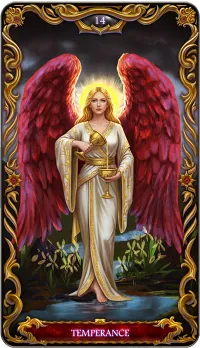 The Star + Temperance: replenishment develops through patience, balance, and steady care.
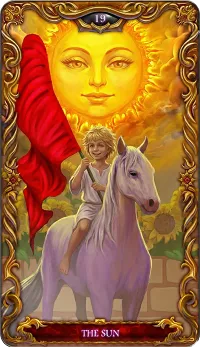 The Star + The Sun: quiet hope meets greater visibility and clarity.
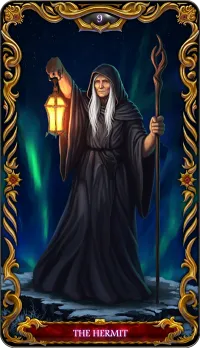 The Star + The Hermit: private reflection helps identify a trustworthy point of direction.
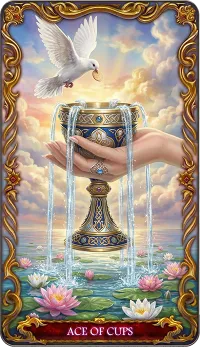 The Star + Ace of Cups: emotional openness begins to flow again after depletion.
Each pairing changes with its question and spread position. The dedicated pair pages explore their combinations in greater depth without turning them into fixed outcomes.
How to apply The Star in a reading
Begin with the three questions: What is depleted or specifically disappointing? What evidence of support or possibility remains? What small action could reopen flow without pretending certainty?
Hypothetical scenario: A person feels directionless after a plan ends. Rather than asking whether everything will improve, they name the exact resource that ran low, notice one relationship or practice that still offers support, and choose one manageable way to re-engage. The Star functions here as a reflective structure for choice, not evidence about the future.
If the card is reversed, identify the pattern before choosing the response. A specific disappointment may need acknowledgment; discouragement may call for a smaller experiment; blocked hope may require separating possibility from one expected form; difficulty receiving support may invite testing help before dismissing it. None of these steps requires false brightness.