Minor Arcana · Swords · Eight
Eight of Swords
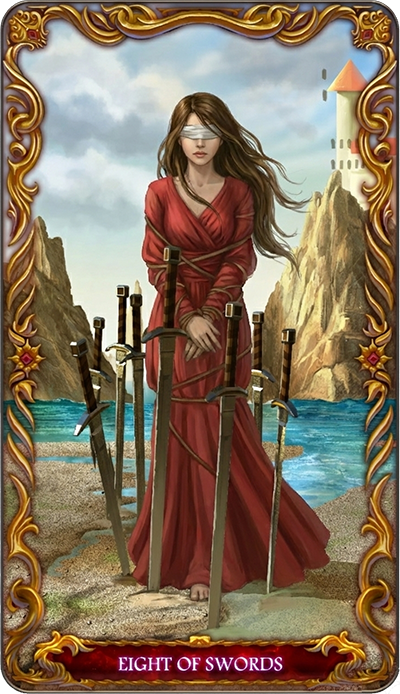
The Eight of Swords tarot card meaning centers on restriction, self-imposed limits, feeling trapped, and the first clear thought that loosens the bind.
- Suit
- Swords
- Rank
- Eight
- Number
- Eight
- Element
- Air

Eight of Swords Tarot Card: Meaning, Reversed, Love & Career
What does the Eight of Swords mean?
The Eight of Swords means restriction, self-imposed limits, and feeling trapped inside a mental pattern. It often appears when fear has made the situation look smaller than it really is. Reversed, the Eight of Swords shows release, a new perspective, and the beginning of choice returning.
Eight of Swords upright meaning
Upright keywords: restriction, self-imposed limits, feeling trapped
Upright, the Eight of Swords is the moment the mind says, I cannot move, while the cards quietly show that some movement is still possible. This card does not dismiss the difficulty around you. It simply asks whether every wall is truly a wall, or whether some of them are thoughts repeated so often they have started to feel like stone.
In the Rider-Waite-Smith image, a blindfolded woman stands bound among eight swords. The ground around her is wet, and a castle sits in the distance. The scene is uncomfortable, but it is also precise: the swords do not form a locked cage. Her feet are not fully trapped. The blindfold matters because perception is the central issue. Air has become a loop instead of a window.
In a reading, I treat this card with care. The Eight of Swords often appears when someone has learned to make themselves small to stay safe, accepted someone else’s version of the story, or talked themselves out of the one action that would change the whole shape of the situation. The pattern here is not weakness. It is overprotection. The mind is trying to prevent pain by limiting possibility.
The practical message is to name the bind accurately. What is fact? What is fear? What is an old rule you inherited? What is the smallest action that proves you still have agency? The cards show a narrow path, not no path. You do not have to leap. You may only need to remove one thread at a time.
Eight of Swords reversed meaning
Reversed keywords: release, new perspective
Reversed, the Eight of Swords shows the blindfold loosening. This does not always mean the entire situation changes at once. More often, it means your relationship to the situation changes first. A thought that used to feel absolute begins to show its edges. A sentence like I have no choice becomes I have one hard choice, and that is already different.
This reversal can bring release through information, therapy, rest, honest conversation, or simply the courage to admit that a story has been running your life. It can also feel unsettling, because freedom requires responsibility. Once you see the opening, you cannot fully pretend it is not there.
Sometimes the reversed Eight of Swords warns against rushing the process of liberation. If you have been mentally bound for a long time, your nervous system may not trust freedom immediately. Start with one clean act of agency: ask the question, send the message, decline the obligation, gather the facts, or write down what you know without apologizing for knowing it.
The deeper invitation is perspective. The cards are not saying your fear is silly. They are showing that fear is not the only authority in the room. Your body may feel the first loosening before your mind believes it. Notice the breath. Notice the shoulders. Something in you remembers how to move.
Eight of Swords in love and relationships
In love, the Eight of Swords can show feeling stuck in a relationship pattern, afraid to speak, or convinced that every option will hurt. Reversed, it may show the first honest conversation, the decision to stop self-silencing, or a clearer view of what is and is not yours to carry.
Eight of Swords in career and money
In career and money, the Eight of Swords points to limiting beliefs, unclear options, workplace pressure, or fear of making the wrong move. Reversed, it supports gathering facts, asking for help, updating your plan, and taking one practical step that proves the situation has more space than it first appeared to have.
Eight of Swords symbolism
The Eight of Swords shows a blindfolded, bound figure surrounded by swords near water and a distant castle. The swords represent thoughts, rules, fears, and perceptions. The blindfold suggests limited vision. The open spaces between the swords matter: the card shows restriction, but not a closed prison.
The Minneapolis Institute of Art catalogues a 1751 Eight of Swords, accession P.96.30.59, as a hand-colored woodcut from the Tarot of Marseilles attributed to Claude Burdel. Its record describes eight curved swords interlaced at the top and bottom, a floral design between them, and VIII printed at both sides. This dated object documents a catalogued Eight card, while the named interpretations discussed below belong to separate textual sources; their later sequence does not by itself establish lineage or shared meaning.
Why Book T and Waite Describe the Eight Differently
In the supplied modern reproduction of Book T, the Eight is the “Lord of Shortened Force”: the text describes four hands holding eight swords, with Jupiter and Gemini symbols, then warns of attention spent on small matters at the expense of larger ones. Its account is deliberately mixed—patience, care, generosity, and cleverness sit beside disorder, impulsiveness, selfishness, and weak affection—and its “ill dignified” clause adds malice, pettiness, and domineering traits. That dignity language belongs to this named system and is not automatically a reversed-card meaning.
In the supplied modern web reproduction of Waite’s Pictorial Key, the Eight instead shows a bound, hoodwinked woman. Waite calls the condition “temporary durance” rather than irretrievable bondage, but the surrounding entry is not simply reassuring: it follows with adverse divinatory meanings such as bad news, conflict, and sickness, then gives a separate reversed list including difficulty, opposition, treachery, the unforeseen, and fatality. These are attributed historical terms, not a diagnosis, promise of escape, or prediction for the reader.
Tarotologist’s fact, fear, and agency lens is a separate modern house interpretation, not historical evidence about either text. It can help you distinguish an observable constraint from an inference and notice where choice remains, while still allowing that some barriers are external and genuine. Reading the source label first keeps Book T’s dignity convention, Waite’s reversal list, and this page’s reflective approach from being mistaken for one universal meaning.
Correspondences
- ElementAir
Eight of Swords is attributed to Air in the Golden Dawn / Book T system.
Eight of Swords tarot combinations
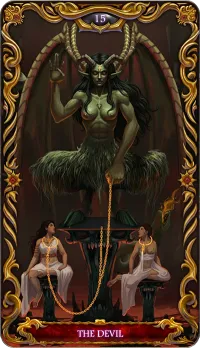 Eight of Swords + The Devil: a limiting pattern becomes visible enough to question.
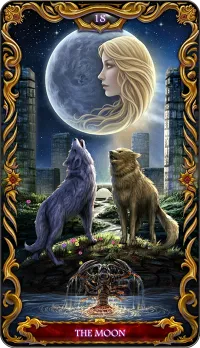 Eight of Swords + The Moon: fear and uncertainty may be shaping the story more than facts.
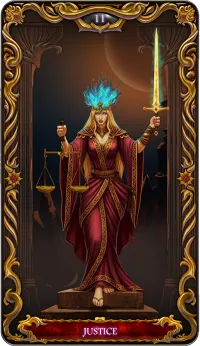 Eight of Swords + Justice: clear evidence helps separate responsibility from self-blame.
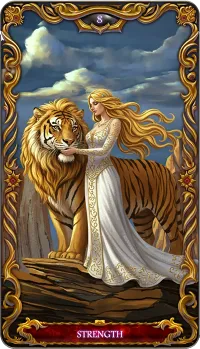 Eight of Swords + Strength: gentle courage loosens a bind that force would only tighten.
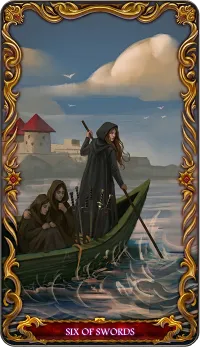 Eight of Swords + Six of Swords: a new perspective begins the movement away from mental confinement.
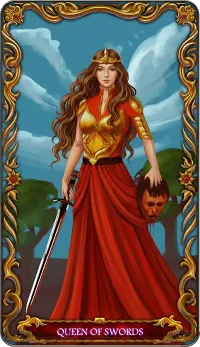 Eight of Swords + Queen of Swords: a boundary or honest statement cuts through the illusion of no choice.
Eight of Swords reversed with Queen of Swords upright
In this Tarotologist house interpretation, Eight of Swords reversed suggests that an option or new perspective is beginning to appear, even if the whole situation has not changed. Queen of Swords upright gives that opening a clearer form: a precise question, an honest statement, or a compassionate boundary, drawing on the Queen’s discerning and principled approach without treating confidence as proof that the conclusion is correct.
Read both cards through the real question and any positions they hold, using the contextual method for interpreting card interactions rather than assigning them fixed roles. Ask what option is now visible, which observable facts support it, what can be said clearly and kindly, and what remains unknown; neither card proves complete release, another person’s intentions, consent, safety, repair, or a future outcome.
A first-person reading example
In a reading, I would place the Eight of Swords down gently. I would not tell you that your fear is imaginary, because fear often has a history. I would ask where you learned that speaking up costs too much. Then I would look for the one sword that is not actually blocking the path. If this is about love, I would ask what truth you have been editing to keep the peace. If this is about work, I would ask which option you dismissed before you gave it a fair hearing. The cards show restriction, yes. But they also show the bind beginning in the mind, which means the first release can begin there too. The cards illuminate. You decide.
A present-position example
Here is a fictional example: someone asks what to check before sharing a sketch with their drawing group, and the upright Eight of Swords appears in the Present position. In this method, Present describes the current state: the observable fact is that the sketch has not been shared yet, while “the group will think I have no talent” is a feared conclusion that has not been tested.
The card does not prove the worry is baseless or that every barrier is imagined. If it feels useful, the person could gather one small piece of real-world information—such as checking the group’s submission guidelines or asking whether unfinished work is welcome—before choosing whether to share.
The Three-Card example above is one hypothetical upright draw: in Present, the Eight describes the current state without proving that its feared conclusion is true or that every obstacle is self-created. In a separate hypothetical reading, imagine the upright Eight drawn in Celtic Cross Position 9 — Hopes & Fears. There it can reflect an inner expectation that the outcome will leave no workable choice, or a hope that clearer sight will loosen the bind; Position 9 describes those hopes and fears, not the outcome itself.
Keep the real question and surrounding cards in view. They may show genuine limits, missing information, or options fear has made harder to see, so neither draw establishes present facts or future events.
A fact-and-assumption reflection spread
For this new Tarotologist house adaptation, deliberately choose the upright Eight of Swords as an anchor, remove it from the deck, and set it aside face up. Shuffle the remaining deck, then draw three other cards from left to right so that four cards are visible and the anchor is not one of the three positions.
- Read the first drawn card as a prompt to list what you can directly observe about the constraint, without asking the card to decide which facts are true.
- Read the second drawn card as a prompt to notice an assumption, inherited rule, or repeated story that may be narrowing how you see the situation.
- Read the third drawn card as a prompt to choose one small real-world action that could gather useful information while respecting any genuine barrier.
Compare each prompt with your observations and the wider context, and leave room for uncertainty and your own choice; the cards cannot prove that a fear is imaginary or establish facts about the situation. This adaptation borrows a position-by-position and synthesis process from the three-card layout method, but its observation, assumption, and information-gathering roles are not that guide’s Past, Present, and Future positions.
Frequently asked questions
Is the Eight of Swords a yes or no card?
The Eight of Swords is usually not a clean yes. It asks you to pause and notice where fear, assumptions, or pressure are narrowing your view. Upright, it suggests waiting until you can see more clearly. Reversed, it can support a cautious yes as agency returns.
What does the Eight of Swords mean in love?
In love, the Eight of Swords can show feeling trapped, afraid to speak, or unable to see a relationship clearly. It may point to self-silencing, overthinking, or fear of consequences. Reversed, it suggests perspective returning and a more honest choice becoming possible.
What does the Eight of Swords reversed mean?
The Eight of Swords reversed means release, new perspective, and the loosening of a mental bind. It can show someone realizing they have more options than they thought. The change may be gradual, but one clear thought can begin to reopen the path.
Is the Eight of Swords a bad card?
The Eight of Swords is not a bad card, but it can feel uncomfortable because it names restriction. Its gift is that it shows where the bind may be partly mental, learned, or outdated. That does not make it easy. It makes it workable.
What is the Eight of Swords associated with?
The Eight of Swords is a Minor Arcana Swords card associated with air, the number 8, and patterns of thought that restrict movement. It connects with perception, fear, self-limitation, careful release, and the return of agency through clearer seeing.
What does the Eight of Swords mean for career?
For career, the Eight of Swords can point to feeling boxed in by a job, manager, contract, or fear of change. It asks for facts, not panic. Reversed, it supports updating your strategy and taking one practical step toward more freedom.