Minor Arcana · Wands · Court
Knight of Wands

The Knight of Wands tarot card meaning centers on action, adventure, bold movement, desire, courage, impulsiveness, and fire that needs direction.
- Suit
- Wands
- Court rank
- Knight
- Element
- Fire

Knight of Wands Tarot Card: Meaning, Reversed, Love & Career
What does the Knight of Wands mean?
The Knight of Wands means action, adventure, bold movement, desire, and impulsive fire. Reversed, the Knight of Wands can show recklessness, haste, inconsistency, frustration, or the need to slow down long enough to aim your energy instead of simply releasing it.
Knight of Wands upright meaning
Upright keywords: action, adventure, impulsiveness
Upright, the Knight of Wands is fire on horseback. Unlike the Page, who studies the spark, the Knight acts on it. This card brings motion, appetite, confidence, and the willingness to cross distance for what feels alive.
In the Rider-Waite-Smith image, the Knight rides a rearing horse through a hot landscape, wand raised, cloak and tunic marked with salamanders. Everything about the card suggests movement. The question is whether that movement has direction.
In everyday readings, this can be taking a trip, making the first move, launching quickly, pitching an idea, leaving a stale situation, pursuing a passionate connection, or finally acting after months of waiting for certainty.
The practical message is courage with steering. The Knight of Wands is useful when fear has made life too small. It is less useful when adrenaline is mistaken for guidance. Before you charge, ask what you want, what the consequences are, and whether your fire is carrying devotion or only impatience.
Knight of Wands reversed meaning
Reversed keywords: recklessness, haste
Reversed, the Knight of Wands often shows fire without brakes. Someone may move hot and cold, promise more than they can sustain, leap before checking the ground, or confuse intensity with maturity.
This reversal can show impulsive spending, reactive texts, quitting dramatically, rushing a launch, or chasing novelty because stillness feels uncomfortable. In love, it can be chemistry that burns bright but does not yet have reliability.
Sometimes the reversed Knight is not saying “do nothing.” It is saying “do not let urgency make the decision for you.” The body may feel charged, but charged is not the same as clear.
The correction is direction. Slow the horse for long enough to name the destination. If the desire is still true after one grounded breath, it will survive a better plan.
Knight of Wands vs Knight of Swords
Both Knights move with speed, but Tarotologist’s house reading distinguishes them by what drives the charge. The Knight of Wands turns fire, desire, and appetite into bold action, while the Knight of Swords turns air, ideas, and intellectual ambition into direct communication or strategy.
In a reading, ask where the momentum begins. If it begins with wanting to pursue, experience, or create something, the Wands emphasis is stronger; if it begins with a thought that needs to be stated, defended, or acted on, the Swords emphasis is stronger. The question and spread position still decide how constructively that speed is being used.
Knight of Wands in love and relationships
In love, the Knight of Wands can show passion, pursuit, chemistry, travel, bold honesty, or a connection that wakes up desire. Reversed, it may show inconsistency, recklessness, hot-and-cold behavior, rushing intimacy, or attraction that needs steadier actions before trust can grow.
Knight of Wands in career and money
In career and money, the Knight of Wands supports bold moves, launches, travel, entrepreneurship, presentations, and decisive action. Reversed, it may show hasty choices, impulsive spending, unfinished projects, frustration with delays, or the need to build a plan before charging ahead.
Knight of Wands symbolism
The Knight of Wands shows an armored rider on a rearing horse, holding a sprouting staff. The horse represents force and momentum. The desert landscape emphasizes heat and ambition. Salamanders on the clothing connect the Knight to elemental fire, transformation, and appetite for experience.
Correspondences
- ElementFire
Knight of Wands is attributed to Fire in the Golden Dawn / Book T system.
Why the court name changes between systems
In Book T’s royal-card descriptions, mounted figures are introduced as Kings, yet the mounted Wands figure is headed “Knight of Wands”; the chariot-borne Prince of Fire is headed “King of Wands.” The repeated names therefore do not, by themselves, identify the same court function across Book T and Rider-Waite-Smith.
Benebell Wen adopts an RWS-Knight/Thoth-Prince comparison in her Knights and Princes teaching, while her Kings teaching notes that court crosswalks are debated. Under that comparative convention, the RWS Knight corresponds by inference to Book T’s chariot function: Air of Fire, with the last Cancer decan and first two Leo decans. Book T’s differently functioning mounted “Knight of Wands” is Fire of Fire and spans the Scorpio/Sagittarius sector. These are system-specific symbolic fields, not Waite’s stated intent, a universal identity, or personal astrology: check the deck and system before transferring them, and read Air of Fire as a rank-within-suit layer rather than a replacement for the Wands suit’s fire.
Knight of Wands tarot combinations
 Knight of Wands + The Chariot: strong momentum succeeds when disciplined by direction.
 Knight of Wands + Seven of Cups: many desires compete; choose before acting.
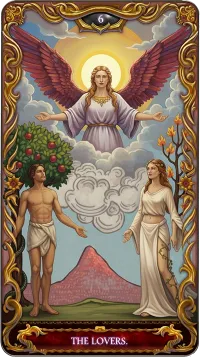 Knight of Wands + The Lovers: chemistry demands a conscious choice, not only attraction.
 Knight of Wands + Five of Swords: impulsive action may create conflict or regret.
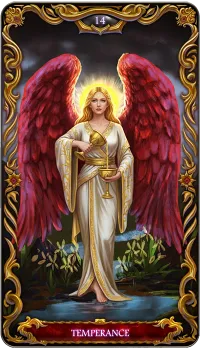 Knight of Wands + Temperance: passion needs pacing and moderation.
 Knight of Wands + King of Wands: raw drive matures into strategic leadership.
A first-person reading example
In a reading, I would ask what your fire is trying to prove. The Knight of Wands can be gorgeous medicine when fear has kept you stuck. It can also be the card that shows a person moving faster than their integrity. If this is love, I would look for consistency beneath the chemistry. If this is work, I would ask whether the bold move has a map. The cards show motion and desire. They ask for aim.
Knight of Wands upright in Present versus Self
In one hypothetical reading, imagine the upright Knight of Wands drawn in the Three-Card Present position, where it prompts reflection on the current state of the situation: What pursuit, launch, journey, first move, or rush of momentum is actually under way, and where is it headed? The card supplies a lens of bold motion and appetite, not proof that the movement is constructive; observations and circumstances—not the card—establish the facts, and this draw does not establish anyone’s readiness, intentions, or outcome.
In a separate hypothetical reading, the same upright themes in Celtic Cross Position 7 — Self concern state of mind and self-perception: perhaps you see yourself as bold, adventurous, restless, impatient, or ready to act. That self-image is not an objective measure of readiness, permission from the situation, advice, another person’s intent, or the outcome. Visible momentum does not prove you feel ready, and feeling ready does not prove circumstances support action, so return to the real question, surrounding cards, consequences, and observable follow-through.
A momentum-and-direction reflection spread
For this new Tarotologist house adaptation, deliberately choose the upright Knight of Wands as an anchor, remove it from the deck, and set it aside face up. Shuffle the remaining deck, then draw three other cards from left to right so that four cards are visible and the anchor is not one of the three positions.
- Read the first drawn card as a prompt to name what genuinely motivates movement, apart from the pull of novelty or urgency.
- Read the second drawn card as a prompt to consider one consequence or real constraint that needs to steer the momentum.
- Read the third drawn card as a prompt to define the observable follow-through that would show your energy has a direction.
Compare the three roles, and if motivation still holds after you consider its consequences, choose a next step you can later check through your own actions and context. The cards offer prompts rather than evidence of another person’s intentions or a guaranteed decision; this adaptation borrows a position-by-position and synthesis process from the three-card layout method, but its motivation, steering, and follow-through roles are not that guide’s Past, Present, and Future positions.
Frequently asked questions
Is the Knight of Wands a yes or no card?
The Knight of Wands leans according to context rather than giving one fixed answer. Upright, it supports choices aligned with action and honest action. Reversed, it asks you to pause if recklessness or reaction is shaping the situation.
What does the Knight of Wands mean in love?
In love, the Knight of Wands can show passion, pursuit, chemistry, travel, bold honesty, or a connection that wakes up desire. Reversed, it may show inconsistency, recklessness, hot-and-cold behavior, rushing intimacy, or attraction that needs steadier actions before trust can grow.
What does the Knight of Wands reversed mean?
The Knight of Wands reversed often points to recklessness, haste. It asks where the card’s fire is blocked, scattered, overextended, avoided, or ready to be handled with more honesty.
Is the Knight of Wands a bad card?
The Knight of Wands is not a bad card. It describes a real life pattern with useful and difficult expressions. The challenge is to meet the card honestly without panic, denial, or turning the symbolism into a fixed prediction.
What is the Knight of Wands associated with?
The Knight of Wands is a Minor Arcana Wands card associated with the element of fire, the rank of knight, and the practical lessons of desire, action, courage, and creative energy. The exact message still depends on the question and surrounding cards.
What does the Knight of Wands mean for career?
In career and money, the Knight of Wands supports bold moves, launches, travel, entrepreneurship, presentations, and decisive action. Reversed, it may show hasty choices, impulsive spending, unfinished projects, frustration with delays, or the need to build a plan before charging ahead.